From the book Impact by Design

The Impact Compass

Four dimensions that decide whether change lasts.

About the Impact Compass

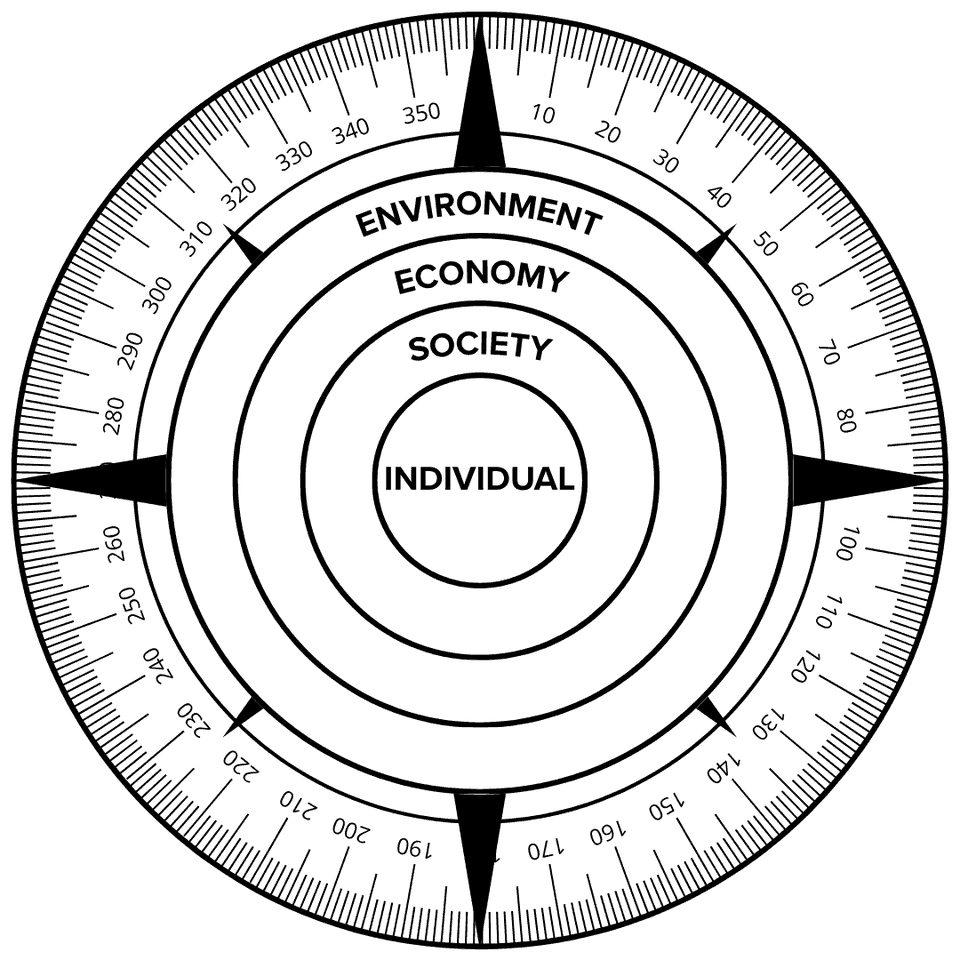
The Impact Compass is a framework for designing and evaluating lasting impact across the environmental, economic, social and individual dimensions. Berfu Ege Sobe developed it after observing successful and unsuccessful efforts around the world, in companies, development programmes, public policy and advocacy. The same pattern appeared each time. Initiatives that created lasting change had addressed all four dimensions, and those that failed or faded had neglected at least one. The Impact Compass brings the four dimensions together in one framework, including the individual dimension that most frameworks leave out.

The Impact Compass: four rings labelled Environment, Economy, Society and Individual, with Individual at the centre, set inside a compass dial.

The four dimensions

01

Environmental

The environmental dimension covers the natural systems every activity depends on and affects, from climate and biodiversity to land, water, air and waste. It includes the planetary boundaries that everything has to operate within, as well as environmental systems beyond our planet.

02

Economic

The economic dimension is about how value is created, distributed and sustained. It goes beyond finance, profit and GDP to the conditions that let people and organisations take part in an economy. These include access to capital, functioning markets, technology and the rules that decide who has economic power.

03

Social

The social dimension covers the systems and structures through which people live and make decisions as a collective. It includes communities, institutions, policies and cultural norms, along with the trust, inclusion and equity that run through them. It is often the most politically complex of the four.

04

Individual

The individual dimension is about what changes for one person, in their wellbeing, physical and mental health, skills, confidence, dignity, freedom and agency. It covers the people an initiative serves and the people who deliver it, from farmers and machine operators to staff and managers. People carry out policies, run programmes and change systems, so this dimension is at the centre of the other three. It is also the one most impact frameworks leave out.

How the dimensions work together

The four dimensions have no ranking and no fixed order. A case can be made for any one of them coming first. Without a stable environment, no system lasts, and without material security, social and individual progress stalls. Without equity and trust, the gains go to a few. Without human agency, nothing moves at all. Each argument is partly right, and none is complete on its own.

In reality, all four dimensions pull on each other. When the economics stop working, an initiative drifts away from its social and environmental goals, however well those were designed. When the environment is ignored, the business model eventually runs into physical limits it never planned for. When the individual is ignored, programmes keep running on paper while the people inside them stop carrying them forward. That is why the Impact Compass keeps all four in view at the same time.

Using the Impact Compass

The Impact Compass can be used to design effective impact efforts and to evaluate or measure them afterwards.

To design new work

Before committing money and people, go through each dimension in turn. For each one, set out what the work should change, what it depends on and what could go wrong.

To evaluate existing work

For a programme, product, policy or portfolio that is already running, the Compass shows what the work covers and where its blind spots are. Go through the four dimensions one at a time and name what has changed in each, including the changes nobody planned for.

Most work is stronger in two or three dimensions than in the others. The weakest dimension is usually where it will break.

Outputs, outcomes and impact

The Compass works at the level of impact. Impact by Design separates three things that often get reported as one. Outputs are what an initiative produces, outcomes are what people start doing differently, and impact is the lasting change in real conditions, measured against what would have happened anyway.

The Compass in practice

In the mid-2000s, the PlayPump looked like one of the best ideas in development. A children's merry-go-round was connected to a water pump, so every turn lifted water into a storage tank. US donors put $16.4 million behind installing it across southern Africa.

Its backers counted pumps installed. Seen through the Impact Compass, the trouble shows up in three of the four dimensions.

Environmental
No major problem. The pump drew groundwater like any borehole.
Economic
Each PlayPump cost about $14,000, enough for several conventional hand pumps. Upkeep was meant to come from adverts on the water tanks, yet in Zambia in 2007, 75% of tanks carried none. In Mozambique, broken pumps stood idle for up to 17 months.
Social
Women in Mozambique said nobody asked them before the PlayPump arrived. Working hand pumps were taken out to make room, and villagers had no say over the pumps or the adverts on them.
Individual
The pump needed constant force to turn. When the children stopped playing, the work fell to women, who said it was much harder than the old hand pump, especially for older women.

PlayPumps International shut down in 2010, and many villages got their hand pumps back. Pumps installed is an output. The Impact Compass asks what changed for the people expected to use them, and that is where this idea broke.
Questions

How is the Impact Compass different from ESG or the triple bottom line?

ESG looks at environmental, social and governance factors, and the triple bottom line at people, planet and profit. Both are mostly used to report on an organisation as a whole. The Impact Compass adds the individual dimension and is built to design and evaluate a specific piece of work, from one project to a whole portfolio. It can be used alongside existing ESG reporting.

Is it a measurement tool?

The Impact Compass is a framework for design and evaluation. Teams attach their own indicators to each dimension, using the measures they already report on or the ones their funders ask for. Impact by Design includes practical tools for building and measuring impact.

Does every project need to be strong in all four dimensions?

Most work is stronger in some dimensions than in others, and that is normal. The aim is to know where each dimension stands and to make sure none is working against the rest. The risk is a weak dimension that nobody has looked at.

Who can use it?

Anyone responsible for change that should last. Companies can use it to test products, supply chains and sustainability strategies, and funders and investors to compare opportunities. Governments, NGOs and social enterprises can use it to design programmes and policies.

Can I reference the Impact Compass in my own work?

Yes. Please credit Berfu Ege Sobe and Impact by Design, using the citation below. For workshops or training built on the framework, get in touch through the contact page.

Cover of Impact by Design by Berfu Ege Sobe

Read the full framework

Impact by Design: Creating Certainty and Impact in a World of Complexity sets out the Impact Compass in full, with cases from business, policy and civil society, and practical tools for building and measuring impact. It became a #4 bestseller worldwide in sustainability and impact books.

Read Impact by Design

Bring the Impact Compass to your organisation

Sobe uses the Impact Compass in keynotes and working sessions with companies, funders, governments and NGOs. A keynote introduces the four dimensions and what they reveal. A working session puts a live programme, portfolio or strategy through the Compass.

How to cite

Sobe, Berfu Ege. (2026). Impact by design: Creating certainty and impact in a world of complexity. Atlas Impact Publishing.